Trademark, copyright and patent complaints can block listings or suspend an account. The right response depends on the complaint type and the brand owner’s claim.
What this notice means
An IP complaint means a rights owner has reported one of your listings under Amazon’s intellectual property policy for trademark, copyright or patent infringement.
Amazon usually removes the listing first and asks questions later.
A single complaint may only affect one listing.
Repeated IP complaints, however, damage Account Health and can lead to deactivation of the whole account, so each one needs to be handled properly.
There are several ways to resolve an IP complaint.
The right one depends on the type of complaint and the facts: a retraction from the rights owner, proof that the product is genuine (invoices) for trademark complaints, showing the complaint was filed in error, or a counter-notice for copyright where available.
The notice usually includes a complaint ID and the rights owner’s contact details.
Keep both, because they are needed for almost every path to resolving the complaint, including a retraction request.
It is also worth checking whether any of your other listings could attract a similar complaint, so they can be reviewed before a second complaint arrives.
If several of your listings have been reported, each complaint usually needs its own response.
Handling them one by one, with the right evidence for each, protects your Account Health better than a single general reply to all of them.
What Amazon needs to see in your appeal
Understand the real cause
Amazon first needs to see that you understand the complaint: which right was claimed, by whom, and against which listing. Each type of IP complaint is handled differently.
Find the root cause
It then needs the root cause: why the listing attracted the complaint. For example, selling a branded product without traceable invoices, using images or text you did not create, or a listing that genuinely overlapped with a protected design.
Fixes already done
Corrective actions already completed come next, such as keeping the product unlisted, correcting listing content, or obtaining a retraction or supporting invoices.
Prevention for the future
Finally, Amazon wants preventive measures: how you will check products and listing content against IP rights before listing in future, so the same complaint does not happen again.
Unlike most suspensions, an IP complaint involves a third party: the rights owner. The response therefore has to satisfy Amazon and, in many cases, the rights owner as well.
Why first appeals get rejected
- Arguing against the complaint without evidence.
- Contacting the rights owner aggressively, which can make a retraction less likely.
- Relisting the removed product while the complaint is still open.
- Submitting invoices that do not cover the product named in the complaint.
IP complaints are legal claims, so the response has to be precise. A short, factual reply that matches the type of right claimed and is backed by the right documents is far more effective than a long argument.
Where the rights owner is open to it, a retraction is often the cleanest outcome, because it removes the complaint from your account rather than just answering it.
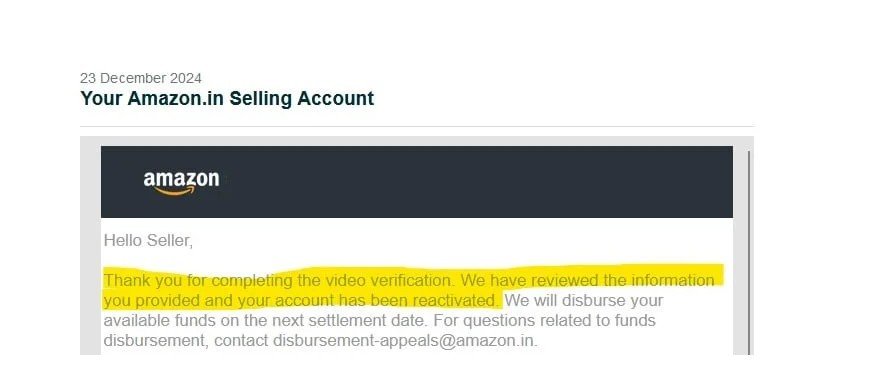
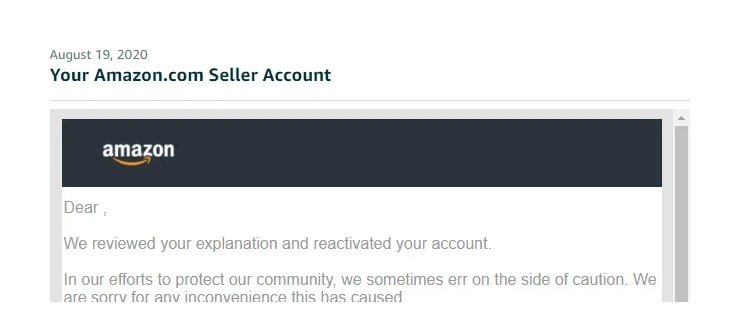
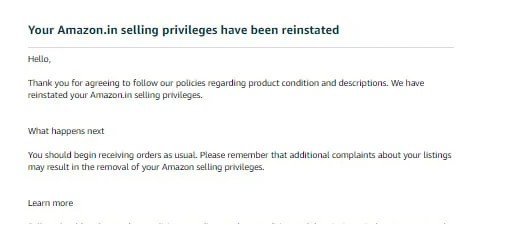
Real reinstatement results
Documents we usually need
- The complaint ID and the rights owner’s details
- Supplier invoices for the product involved
- Authorization letters, if you have them
- Your listing details as they were before removal
Which documents matter most depends on whether the complaint is about a trademark, a copyright or a patent. We confirm this after the free review.
If you have had IP complaints before, include those details too. Amazon looks at the history of complaints on an account, not just the latest one.
If you created your own listing images or text, keep the original files and the dates they were made. For copyright complaints, this kind of record can help show the content is yours.
How we handle your case
- Free review of the complaint. You send the complaint notice and listing details. We tell you honestly which path is realistic.
- Choose the right path. Retraction, proof of genuine product, showing the complaint was filed in error, or a counter-notice for copyright where available.
- Prepare the response. We write the response and, where appropriate, a professional message to the rights owner, with the documents that support it.
- Submission and follow-up. We submit through the correct channel and follow up until Amazon or the rights owner responds.
Throughout the process we keep the affected product unlisted and review your remaining listings, so the account does not pick up further complaints while this one is being resolved.
What we need from you
- Share the full, honest history: all notices, earlier appeals and any linked accounts.
- Send genuine documents only. Edited or fake documents end the case, and the upfront fee is not refunded.
- Reply within 3 days. After 7 days without a reply, the case is closed and the upfront fee is not refunded.
- Pay the balance within 48 hours of Amazon’s reinstatement email.
The free review covers reading your notice only. We investigate your account after the upfront fee is paid, so every hour goes to sellers who are serious about getting their account back.
Fees and timeline
This is a standard case: $150 to start and $350 only after reinstatement ($500 total). The upfront fee is non-refundable and covers our full investigation. Reading your notice is free. Timing depends on Amazon’s review queue and how quickly documents are ready; we follow up on every submission until Amazon responds.
Frequently asked questions
What happens if Amazon rejects the appeal?
We keep working on your case at no extra cost. We revise the Plan of Action, resubmit and escalate where possible, until your account is reinstated or Amazon gives a final decision with no further appeal route. This covers the same case only; a new notice or a new violation is a new case. It depends on you replying and sending documents on time, as set out in “What we need from you”. You pay the balance only after reinstatement. No one can guarantee Amazon’s decision.
Can one IP complaint get my account deactivated?
A single complaint usually affects one listing. Repeated IP complaints damage Account Health and can lead to deactivation, so each one should be resolved properly. Keeping your listings clean is the best protection.
Should I contact the rights owner directly?
Sometimes a polite, professional request for a retraction is the right path. Aggressive contact usually makes things worse, so it is worth planning the message first. We can help draft a short, factual message if a retraction is the right path.
Are invoices enough to resolve a trademark complaint?
For trademark complaints, invoices proving the product is genuine can help, but they must cover the exact product named in the complaint. Invoices for a similar product, or a different brand, will not resolve the complaint.
Can I relist the product while I wait?
No. Relisting a removed product while the complaint is open can lead to further action on the account. Keep it unlisted until the complaint is resolved.
What if the complaint was filed by mistake?
Then the response needs to show clearly why it was filed in error, with evidence. A retraction from the rights owner is often the cleanest outcome. Evidence matters more than argument in these cases.
Get a free review of your notice
Send the suspension email or a screenshot. You get an honest answer before you pay.