Amazon suspends seller accounts for many reasons. Below are the other suspension types we handle. Each case is reviewed on its own facts, and we will tell you honestly whether we can help.
What this notice means
Not every suspension fits the common categories.
Amazon also deactivates accounts for review manipulation, restricted products, dropshipping policy breaches, deceptive or fraudulent activity concerns, code of conduct violations, buyer-seller messaging abuse and A-to-z claim issues. Each one has its own rules, and each needs an appeal that answers that specific concern.
Review manipulation
Any incentivized, paid or family and friends reviews, or review swapping with other sellers, breaks Amazon’s rules. Amazon looks for proof that the activity has stopped, that any tool or service involved has been removed, and that only Amazon-approved ways of requesting reviews are used now.
Restricted products
Some products cannot be sold at all, and others need approval first. Amazon looks for evidence that the restricted listings have been removed, that you understand which rule applied, and that you check products against Amazon’s restrictions before listing.
Dropshipping policy
Amazon requires you to be the seller of record, to identify yourself on packing slips, invoices and other information included with the order, and not to ship in another retailer’s branding. Amazon looks for a fulfillment process that meets each of these requirements.
Deceptive or fraudulent activity concerns
These cover activity Amazon sees as misleading to buyers or the marketplace. Amazon looks for an honest explanation of what happened and clear evidence that the activity has stopped and cannot recur.
Code of conduct violations
These involve behavior that breaks Amazon’s seller code of conduct, such as misleading buyers or trying to influence their decisions improperly. Amazon looks for an understanding of the specific rule and changes to how the business operates.
Buyer-seller messaging abuse
Messages to buyers must follow Amazon’s communication rules. Amazon looks for evidence that templates and automated messages have been reviewed and that only permitted messages are now sent.
A-to-z claim issues
A high number of A-to-z Guarantee claims suggests buyers are not receiving what they expected. Amazon looks for order-level analysis of the claims and fixes to delivery, product or customer service processes.
What Amazon needs to see
Understand the real cause
Whatever the suspension type, Amazon needs to see that you understand the real cause: which rule was broken and how. A general apology without naming the issue does not show understanding.
Find the root cause
It then needs the root cause: what in your business allowed it to happen. For example, a third-party tool that sent improper review requests, a supplier that shipped in its own branding, or messaging templates that were never checked against Amazon’s rules.
Fixes already done
Corrective actions already completed come next. These are changes that are already in place, such as cancelled services, removed listings, rewritten templates or a new fulfillment arrangement, ideally with proof.
Prevention for the future
Finally, Amazon wants preventive measures that stop the problem returning: who checks what, how often, and against which Amazon policy.
Why first appeals get rejected
- Not giving an honest root cause, or giving a vague one that could apply to any seller.
- Describing changes that have not actually been made yet.
- No evidence that process changes are already in place.
- Missing supplier or fulfillment documents where the issue involves sourcing or shipping.
- Arguing that the rule was unfair instead of explaining how you will follow it.
For these suspension types in particular, honesty carries a lot of weight. Amazon often has records of the activity, so an appeal that matches what Amazon can see is far more credible than one that denies it.
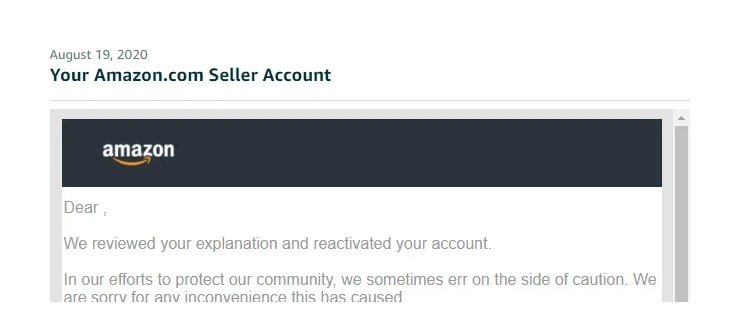
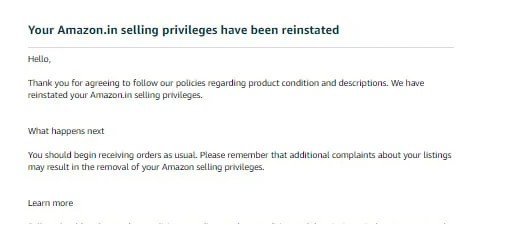
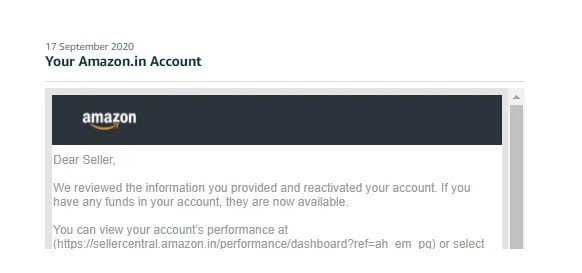
Real reinstatement results
Documents we usually need
- The suspension notice and any related emails from Amazon
- A screenshot of your Account Health page
- Proof that any tool, service or arrangement involved has been cancelled
- Supplier or fulfillment documents where relevant, such as agreements or invoices
- Examples of updated templates, packing slips or processes
The exact list depends on the suspension type. We confirm what your case needs after the free review.
Where a third party was involved, such as a review service, a fulfillment partner or a supplier, written proof that the arrangement has ended or changed is especially useful.
How we handle your case
- Free review of your notice. You send the notice and any related emails. We tell you honestly what is realistic.
- Identify the real issue. We work out exactly which rule Amazon is concerned about and what in the business caused it.
- Plan of Action written for your case. We write the appeal around your facts, with evidence that the changes are already in place.
- Submission and follow-up. We submit through the correct channel and respond to any further requests until Amazon reviews the case.
What we need from you
- Share the full, honest history: all notices, earlier appeals and any linked accounts.
- Send genuine documents only. Edited or fake documents end the case, and the upfront fee is not refunded.
- Reply within 3 days. After 7 days without a reply, the case is closed and the upfront fee is not refunded.
- Pay the balance within 48 hours of Amazon’s reinstatement email.
The free review covers reading your notice only. We investigate your account after the upfront fee is paid, so every hour goes to sellers who are serious about getting their account back.
Fees and timeline
Fees start from $500: standard cases are $150 to start and $350 only after reinstatement; complex cases are $200 to start and $400 only after reinstatement. The upfront fee is non-refundable and covers our full investigation. Reading your notice is free. Timing depends on Amazon’s review queue and how quickly documents are ready.
Frequently asked questions
What happens if Amazon rejects the appeal?
We keep working on your case at no extra cost. We revise the Plan of Action, resubmit and escalate where possible, until your account is reinstated or Amazon gives a final decision with no further appeal route. This covers the same case only; a new notice or a new violation is a new case. It depends on you replying and sending documents on time, as set out in “What we need from you”. You pay the balance only after reinstatement. No one can guarantee Amazon’s decision.
Is dropshipping allowed on Amazon?
Only under Amazon’s dropshipping policy. You must be the seller of record, identify yourself on packing slips and invoices, and not ship in another retailer’s branding.
Are reviews from friends and family allowed?
No. Incentivized, paid, family and friends reviews and review swapping all break Amazon’s rules. The appeal needs to show this activity has fully stopped.
What counts as buyer-seller messaging abuse?
Sending messages that Amazon’s communication rules do not permit, such as marketing messages or improper review requests. Templates and automated messages are often the cause, so they need to be checked.
Can A-to-z claims lead to suspension?
Yes. A high number of claims can affect your account’s performance and lead to action. The appeal needs to show which orders caused the claims and what has changed.
My suspension type is not listed here. Can you still help?
Send us the notice. Many suspension types follow the same appeal principles, and the free review will tell you honestly whether we can help.
Get a free review of your notice
Send the suspension email or a screenshot. You get an honest answer before you pay.