Category: Amazon US

Guides for Amazon.com sellers. Points special to the US store include the DMCA counter-notice route for copyright complaints and the funds appeal to disbursement-appeals@amazon.com after a deactivation.

  • Amazon IP Complaint on Your Listing? 7 Things Amazon Says It Does Not Enforce

    An intellectual property complaint removes your listing first and asks questions later. What the notice does not tell you is that Amazon publishes rules for the people who file complaints, and those rules say what Amazon will not act on.

    By SellerReinstatement Appeals TeamUpdated November 20267 min read

    Quick answer

    Amazon says it does not enforce complaints about true compatibility statements, distribution or minimum-price agreements, a seller simply not being authorised, rights registered in another country, or barcode ownership. If your complaint is one of these, say so in your appeal with specific reasons. If the complaint is about content on your page, remove that content and tell Amazon exactly what you removed.

    Key takeaways

    • Selling a genuine product without the brand’s approval is not counterfeiting.
    • A counterfeit report needs a registered trademark, not a pending one.
    • A complaint against one seller’s offer needs a test buy and an order number.
    • A retraction from the complainant can reinstate the listing. Reports can be retracted for 365 days.
    • UK and EU pages add defences for parallel-import complaints and for trademark notices that come with payment demands.

    Need help with this suspension?

    Send us your notice for a free case review. You get an honest answer before you pay.

    The seven things Amazon does not enforce

    1. True compatibility statements. Amazon does not enforce notices that try to remove a true and clear statement that a product is compatible with a trademarked product.
    2. Exclusive distribution and minimum advertised price agreements. Amazon says violating them is not IP infringement.
    3. “You are not an authorised seller.” Amazon does not check a seller’s authorisation through the infringement form, and says a counterfeit report made only on that basis may not be an infringement complaint.
    4. Rights registered in another country. A trademark or patent must be registered in the country where the complaint is made.
    5. Barcodes. Amazon does not enforce ownership of UPCs or EANs.
    6. Counterfeit claims without a registered trademark. A pending or unregistered mark cannot be the basis.
    7. Complaints used to block competition. Amazon says reporting must not be used to stop others selling the same or a genuine product, and names repeated reports against non-infringing sellers as abuse.

    Two extra defences on the UK and EU pages

    • Parallel-import complaints. Ask the rights owner for a retraction first. If they do not respond, Amazon’s UK page lets you appeal with evidence that the specific products were put on the market in the UK or EEA with the rights owner’s permission, for example invoices from an authorised distributor.
    • Notices that come with payment demands. Amazon’s UK page says it does not tolerate extortionate use of its IP tools and may refuse to act on the notice and reinstate listings. It asks for screenshots of payment demands or evidence that you used the brand first.

    When the complaint is about your page content

    Many complaints concern a word, logo or image on the detail page, not the product. Amazon’s appeal instructions give two routes for a removed listing: submit an appeal, or modify the listing so it complies.

    1. Find the exact word, logo or image named in the notice.
    2. Remove it from the title, bullet points, description, images and search terms.
    3. Appeal from the violation on Account Health and state exactly what you removed, with before and after screenshots.

    Do not delete the listing first. A deleted listing can no longer be edited, and Amazon says deleting it does not address the violation.

    When the complaint is wrong

    • Reply with specific reasons. Amazon’s IP policy lets you explain why a mistake was made. For trademark, add an invoice or Order ID showing the product is authentic.
    • Ask for a retraction. If Amazon receives one from the rights owner, your content may be reinstated. The complainant’s contact details are in your notice.
    • If you never listed the product, reply and say so.
    • On Amazon.com only, a copyright complaint can also be answered with a DMCA counter-notice.

    Why you should check your other listings

    Repeat violations of the same policy cost more Account Health points each time, and Amazon says it terminates the accounts of repeat infringers in appropriate circumstances. After clearing one complaint, look for the same word, logo or image across the rest of your catalogue.

    How our fee works

    A rejected appeal often needs a fresh look rather than another rewrite. You pay a small part to start, and the rest only when you are selling again.

    $150To start: our full investigation ($200 for complex cases). Non-refundable.
    $350Only after your account is reinstated ($400 for complex cases).

    Tap the WhatsApp icon on your screen to start. The first review of your rejection is free.

    Frequently asked questions

    Is selling a branded product without authorisation counterfeit on Amazon?

    Not by itself. Amazon’s guidance to rights owners says it does not check a seller’s authorisation through the infringement form and that a counterfeit report made only because a seller is not authorised may not be an infringement complaint.

    Can I say my product is compatible with a brand?

    Amazon says it does not enforce notices against true statements that clearly indicate compatibility with a trademarked product. The statement must be true and must not suggest the product is made by that brand.

    How long does a rights owner have to retract a complaint?

    Amazon’s Report Infringement guidance says only reports submitted within the last 365 days can be retracted.

    Should I delete the listing after an IP complaint?

    No. A deleted listing cannot be edited to remove the content, and Amazon states that deleting the listing does not address the violation.

    Need help with this suspension?

    Send us your notice for a free case review. You get an honest answer before you pay.

    SellerReinstatement Appeals Team

    The SellerReinstatement appeals team has handled Amazon seller account reinstatement cases since 2014 across every Amazon marketplace. Every guide comes from real cases.

  • Amazon Copyright Complaint in the US: When and How to File a DMCA Counter-Notice

    A copyright complaint on Amazon.com removes your listing and adds a violation to Account Health. Amazon’s US Intellectual Property Policy gives sellers one route that does not exist in most other marketplaces: a counter-notice under the Digital Millennium Copyright Act.

    By SellerReinstatement Appeals TeamUpdated November 20266 min read

    Quick answer

    On Amazon.com, if you believe a copyright complaint is a mistake, you may file a DMCA counter-notice by email to the address in the warning. It must be signed, identify the removed material, state under penalty of perjury that the removal was a mistake, and accept the jurisdiction of a US federal court. Try the simpler routes first: fixing the page, or a retraction from the rights owner.

    Key takeaways

    • The counter-notice route is on Amazon’s US policy page. It is not on the UK or India pages.
    • It applies to copyright complaints only, not trademark, patent or counterfeit complaints.
    • You sign a statement under penalty of perjury and accept US court jurisdiction. Treat it as a legal step.
    • Sellers outside the US consent to the federal court for the Western District of Washington.
    • If the complaint is about an image or text on your page, replacing that content is usually faster.

    Need help with this suspension?

    Send us your notice for a free case review. You get an honest answer before you pay.

    When a counter-notice fits

    Amazon’s policy says that if you believe a rights owner or Amazon made an error in removing your listing for copyright infringement, you may file a counter-notice under the DMCA. It fits when:

    • You created the image or text yourself and can show it, for example with original photo files.
    • You hold a licence to use the work.
    • The complaint identifies the wrong material and your listing does not use the work at all.

    It does not fit when you did copy the image or text. In that case, change the content and appeal.

    What the counter-notice must contain

    Amazon lists these elements on its US policy page:

    1. Your signature. A typed signature in the form /s/ Seller Name is accepted.
    2. Identification of the material that was removed. Amazon says an ASIN is generally sufficient.
    3. A statement under penalty of perjury that you have a good-faith belief the material was removed by mistake or misidentification.
    4. Your name, address and telephone number.
    5. Consent to the jurisdiction of the Federal District Court for the district where your address is. Sellers outside the United States consent to the United States District Court for the Western District of Washington.
    6. A statement that you will accept service of process from the person who filed the complaint.

    It is sent to the email address given in the warning you received.

    What you are agreeing to

    Two of those elements carry real weight. A statement under penalty of perjury is a sworn statement. And by consenting to a US federal court and to service of process, you are telling the complainant where and how they can sue you. For a seller based in India, the UK or the UAE, that court is in Washington State.

    This is why a counter-notice should be sent only when you are sure of your rights in the content, and ideally after speaking to a lawyer. This guide is general information, not legal advice.

    Routes to try first

    SituationRoute on Amazon’s US policy page
    You never listed the productReply to the notification and say so
    You have a relationship with the rights ownerAsk for a retraction. Content may be reinstated if Amazon receives one
    The complaint is about your detail page contentCorrect the page, then appeal from Account Health
    Trademark or counterfeit on the product or packagingAn invoice or Order ID that demonstrates authenticity
    Several warnings at onceA list of the ASINs with invoices, order IDs, an authorisation letter that is not a forwarded email, or a court order

    What to do now

    1. Read the notice and find the complaint type. A counter-notice is for copyright only.
    2. Find the exact image or text the complaint is about.
    3. Decide honestly whether the content is yours. If it is not, replace it and appeal.
    4. If it is yours, gather proof: original files, the date you created them, or your licence.
    5. Contact the complainant using the details in the notice and ask for a retraction before you escalate.
    6. Send a counter-notice only if that fails and you accept the legal commitments above.

    Mistakes to avoid

    • Using a counter-notice for a trademark complaint. It is the wrong tool and wastes an appeal.
    • Sending one for a non-US marketplace. The route is on the Amazon.com policy page only.
    • Signing the perjury statement when you used a supplier’s or competitor’s photos.
    • Leaving the same image on your other listings. Amazon says it terminates repeat infringers in appropriate circumstances.

    How our fee works

    A rejected appeal often needs a fresh look rather than another rewrite. You pay a small part to start, and the rest only when you are selling again.

    $150To start: our full investigation ($200 for complex cases). Non-refundable.
    $350Only after your account is reinstated ($400 for complex cases).

    Tap the WhatsApp icon on your screen to start. The first review of your rejection is free.

    Frequently asked questions

    Can I file a DMCA counter-notice for a trademark complaint on Amazon?

    No. Amazon’s US policy offers the counter-notice for copyright complaints. Trademark complaints are answered with an invoice or Order ID, a corrected detail page, a letter of authorisation or a retraction.

    Where do I send the counter-notice?

    Amazon’s policy says to send it to the email address provided in the warning you received.

    I am not in the United States. Can I still file one?

    Yes for a complaint on Amazon.com, but you must consent to the jurisdiction of the United States District Court for the Western District of Washington and agree to accept service of process from the complainant.

    Does a counter-notice work on Amazon UK or Amazon India?

    The counter-notice route appears on the US policy page. The UK and India policy pages give other routes: a reply with specific reasons, proof of authenticity, or a retraction from the rights owner.

    Need help with this suspension?

    Send us your notice for a free case review. You get an honest answer before you pay.

    SellerReinstatement Appeals Team

    The SellerReinstatement appeals team has handled Amazon seller account reinstatement cases since 2014 across every Amazon marketplace. Every guide comes from real cases.

  • Amazon Holding Your Funds After Deactivation: The 60-Day Appeal in the US, UK and Japan

    When Amazon deactivates a selling account it usually holds the balance as well. The rule that decides when you can ask for that money is the same policy page in every marketplace, but the wording and the dates are not the same in the US, the UK and Japan.

    By SellerReinstatement Appeals TeamUpdated November 20266 min read

    Quick answer

    If your account is not reinstated, Amazon lets you ask for the withheld funds by email once 60 days have passed. In the US and UK the 60 days run from the date the account was deactivated. In Japan they run from the date the funds were withheld. Amazon then checks your identity and looks for fraud before it releases the balance.

    Key takeaways

    • Reinstatement and funds are two separate requests. You can ask for the money even if the account stays closed.
    • US and UK: Amazon says it will release the remaining funds after it evaluates the account for fraud and confirms your identity.
    • Japan: funds are held for 90 days in general, and longer if a risk or an investigation continues.
    • Amazon can keep the money permanently if it finds fraud, abuse or repeated violations, or cannot confirm who you are.
    • A funds request is a document check. Lead with identity and sourcing documents, not with an argument.

    Need help with this suspension?

    Send us your notice for a free case review. You get an honest answer before you pay.

    Which policy applies

    The page is called the Funds disbursement eligibility policy. It applies when Amazon deactivates an account under Section 3 of the Business Solutions Agreement and decides that the seller’s actions may create a risk for Amazon or for a third party.

    Amazon says the held amount can cover returns, refunds, A-to-z Guarantee claims, inventory removal costs and unpaid fees. That is why the figure you see can go down while you wait.

    What each marketplace says

    MarketplaceWhen you can ask for the fundsWhat Amazon commits to
    United States (Amazon.com)Any time after 60 days from the date the account was deactivated, by email to the disbursement appeals address on the policy pageRelease of the remaining funds after a fraud evaluation and identity confirmation
    United Kingdom and EU storesAny time after 60 days from the date the account was deactivatedThe same wording as the US page
    Japan (Amazon.co.jp)Through the appeal in the notice or Seller Central, or by email once 60 days have passed from the date the funds were withheldFunds are withheld for 90 days in general. Release follows identity confirmation and a fraud evaluation

    In every marketplace, if your account is reinstated on appeal, the money is paid on your normal disbursement schedule and no separate request is needed.

    What Amazon checks before it pays

    The policy says Amazon may ask for more information about three things:

    • Your identity. Government ID and business registration that match the account.
    • Your financial instruments. The bank account and the charge card on the account.
    • Your supply chain. Where the products came from.

    Amazon also says it may validate what you send with third-party services or government agencies. Documents that do not match the details on the account are the most common reason these requests stall.

    When Amazon keeps the funds

    The policy allows permanent withholding where Amazon finds deceptive, fraudulent or illegal activity, abuse of its systems, or repeated policy violations. The US and UK pages add one more ground: if Amazon cannot confirm your identity. The examples Amazon gives are falsifying or misrepresenting your identity or activity, and violating the anti-counterfeiting policy.

    So a funds request has two jobs: prove who you are, and show the business was genuine.

    What to do now

    1. Find the deactivation date in your Performance Notifications and count 60 days. In Japan, count from the funds-withholding notice.
    2. Check the notice first. If it gives a funds appeal route inside Seller Central, use that before email.
    3. Send from the registered email address of the account, to the disbursement appeals address shown on the policy page for your marketplace.
    4. Attach identity and bank documents that match the account, and supplier invoices for what you sold.
    5. Keep it short and factual. State the account, the deactivation date, the amount shown in your Payments report and what you attach.

    Mistakes to avoid

    • Asking before the 60 days are up. The request is answered with a standard reply.
    • Telling Amazon you will never sell again in the hope it speeds things up. It does not change the checks.
    • Sending the same rejected invoices. If Amazon doubted them in the reinstatement appeal, it will doubt them here.
    • Relying on mediation in the UK or EU. Amazon’s mediation page excludes payment account disputes.

    How our fee works

    A rejected appeal often needs a fresh look rather than another rewrite. You pay a small part to start, and the rest only when you are selling again.

    $150To start: our full investigation ($200 for complex cases). Non-refundable.
    $350Only after your account is reinstated ($400 for complex cases).

    Tap the WhatsApp icon on your screen to start. The first review of your rejection is free.

    Frequently asked questions

    How long does Amazon hold funds after an account is deactivated?

    Amazon does not give one fixed period in the US or UK. The policy lets you request the funds once 60 days have passed from deactivation. The Japan page says funds are withheld for 90 days in general, and longer if a risk or an investigation continues.

    Can I get my funds if my account is not reinstated?

    Yes, you can ask. The policy gives a separate request for withheld funds after 60 days. Amazon releases them only after it confirms your identity and finds no fraud or abuse.

    Why is the amount Amazon is holding going down?

    Amazon uses the balance to cover returns, refunds, A-to-z Guarantee claims, removal costs and fees that arrive after the deactivation.

    Can Amazon keep my money permanently?

    The policy says it can where it finds deceptive, fraudulent or illegal activity, system abuse or repeated violations. The US and UK pages add the case where Amazon cannot confirm your identity.

    Need help with this suspension?

    Send us your notice for a free case review. You get an honest answer before you pay.

    SellerReinstatement Appeals Team

    The SellerReinstatement appeals team has handled Amazon seller account reinstatement cases since 2014 across every Amazon marketplace. Every guide comes from real cases.

  • Amazon INFORM Act Verification: How to Fix a Deactivation

    Amazon INFORM Act Verification: How to Fix a Deactivation

    Amazon INFORM Act verification is the US identity and bank check that high-volume sellers must pass, and re-certify every year, to keep selling on Amazon.com. When it fails or is missed, the account can be deactivated with no policy complaint at all. This guide explains who must verify, what Amazon checks, and how our appeals team gets these accounts selling again.

    By SellerReinstatement Appeals TeamUpdated November 20268 min read

    Quick answer

    Amazon INFORM Act verification applies to US sellers with 200+ sales and $5,000+ in revenue in any 12-month period. Amazon must collect your bank, tax ID and contact details, verify them, and have you re-certify them at least once a year. If you miss the 10-day deadline or your documents do not match, Amazon must suspend your selling until it can verify you. The fix is usually correct, matching documents, not a long Plan of Action.

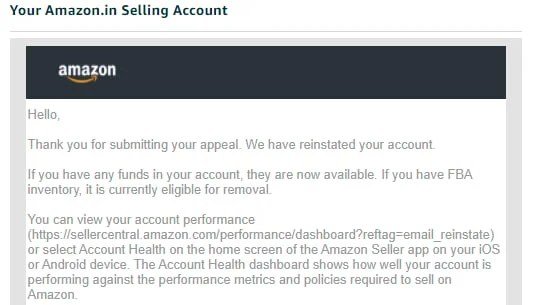
    Real Amazon reinstatement email from one of our client cases, shared with the client's permission
    Real result Amazon email from one of our client cases, shared with permission. Tap to view full size.

    Key takeaways

    • The INFORM Consumers Act is a US law in force since June 27, 2023. It covers the Amazon.com store.
    • You are “high-volume” after 200+ sales and $5,000+ in revenue in any continuous 12 months within the last 24 months.
    • Amazon must collect your bank, tax ID and contact details and get them re-certified at least once a year.
    • Missing the 10-day deadline or uploading mismatched documents leads to deactivation.
    • Most INFORM cases are fixed with correct, matching documents, not a long appeal.

    Deactivated over INFORM verification?

    Send us your notice for a free case review. You get an honest answer before you pay.

    What is Amazon INFORM Act verification?

    The INFORM Consumers Act (Integrity, Notification, and Fairness in Online Retail Marketplaces for Consumers Act) is a US federal law aimed at stopping the sale of stolen, counterfeit and unsafe goods online. It does not create a new Amazon policy you can break. Instead, it makes Amazon collect, verify and in some cases show buyers who is behind each high-volume seller.

    For you, that means one thing: Amazon must be able to confirm your identity, tax ID, bank account and contact details at all times. If it cannot, the law requires Amazon to stop your selling. That is why many sellers see a deactivation notice that mentions verification but no complaint, ASIN or policy breach. The FTC and state attorneys general enforce the law.

    INFORM verification is separate from the general identity verification Amazon runs in every marketplace, but in practice the two overlap: the same documents, the same matching rules, and sometimes the same video verification call.

    Who must complete INFORM verification

    The law applies to “high-volume third-party sellers” on the Amazon US store. Your sales on other Amazon marketplaces do not count toward the threshold.

    Your sales on Amazon.comWhat the law requires
    Under 200 sales or under $5,000 in any 12 monthsNot covered by INFORM, though Amazon can still ask you to verify under its own policies.
    200+ sales of new or unused items and $5,000+ revenue in any continuous 12 months (last 24 months)High-volume seller: Amazon must collect and verify your information and get it re-certified at least once a year.
    High-volume and $20,000+ annual gross revenueAll of the above, plus Amazon must show your name, physical address and contact details to buyers.

    If your only address is your home, the law allows partial disclosure: Amazon shows only your country and state. You can request this in Seller Central.

    Got an INFORM or verification notice? Tap the green WhatsApp icon on your screen and send it to us. Reading it is free.

    What information Amazon collects

    Amazon asks for these details in Seller Central. Exactly which documents it requests depends on whether you sell as an individual or a business.

    • Bank account: the account Amazon pays you into, in a name that matches your seller account.
    • Tax ID: for example an EIN or SSN for US sellers, or your home-country tax number, matching your tax interview.
    • Identity: a government ID for individuals, or a business registration document plus ID for the person representing the business.
    • Contact details: a working email address and phone number.
    • Address: a physical address that matches your documents (shown to buyers if you pass $20,000).
    • Annual certification: confirmation each year that the details are still correct or have been updated.

    We are not tax advisers or lawyers. For questions about US tax IDs or company registration, speak to a qualified accountant.

    Deadlines and annual re-certification

    The law sets short deadlines, and Amazon applies them strictly.

    StepDeadline
    You become a high-volume sellerAmazon must collect your information within 10 days
    You provide your informationAmazon must verify it within 10 days of receiving it
    Annual re-certification requestYou must confirm or update your details within 10 days
    Information not provided or not certified in timeAmazon must suspend your selling until it is fixed

    The most common trap is the yearly re-certification. It arrives as a banner or email, sellers assume it is routine, and the account is deactivated 10 days later. Check Account Health and the Account Information page regularly, and keep your details current whenever your bank, address or phone number changes.

    Why INFORM verification fails

    In the INFORM cases we handle, the problem is almost never the law itself. It is a mismatch Amazon cannot get past.

    Do thisAvoid this
    Use the exact legal name from your ID or business registration everywhere in Seller Central.A shortened, translated or trading name on one document and the legal name on another.
    Upload a recent bank or utility statement that clearly shows your name and the same address.Virtual offices, mail-forwarding or agent addresses as your business address.
    Keep the bank account holder name identical to the seller or business name.A bank account in a relative’s, partner’s or other company’s name.
    Make sure your tax interview name and tax ID match your registration.Changing bank, address or business details in the middle of verification.
    Send clear, complete, unedited color scans.Cropped, blurry, expired or edited documents, or resending one Amazon already rejected.

    How to fix an INFORM Act deactivation

    1. Read the notice and Account Health

    Note exactly what Amazon says is missing or could not be verified, and any deadline. Our guide to deactivated vs suspended explains what the status means.

    2. Check every detail for a match

    Line up your ID, business registration, bank statement, tax interview and Seller Central account. Name, address and account holder must be identical across all of them. Most failed cases break on one small difference.

    3. Fix the details before you resubmit

    Correct the Account Information page first, then gather fresh documents that show the corrected details. Do not upload the same document Amazon rejected.

    4. Submit through Seller Central and keep it short

    Verification problems are solved with documents, not long explanations. If Amazon asks for a Plan of Action or explanation, keep it factual and consistent. Our Plan of Action template shows the structure.

    5. If it is rejected, find the reason first

    Read the reply line by line and change only what Amazon objected to. Our guide on what to do when an appeal is rejected covers this step by step.

    While the account is deactivated, Amazon may hold your funds. Our frozen funds and verification service handles both problems together.

    INFORM verification for sellers outside the US

    INFORM applies to the Amazon US store, not to where you live. Sellers based in India, China, the UK, the UAE and elsewhere are covered once they pass the threshold on Amazon.com. Verification is often harder for them because documents come from another country, may not be in English, and may show the address in a different format.

    Use documents that show your name and address the same way your Seller Central account does, add certified translations where needed, and keep your originals ready in case Amazon asks for a video call. Our Amazon US suspension guide covers the other US-specific triggers.

    Real reinstatement results

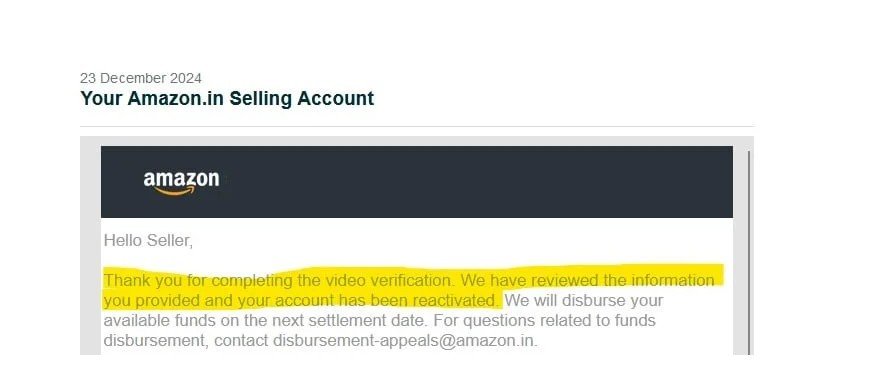
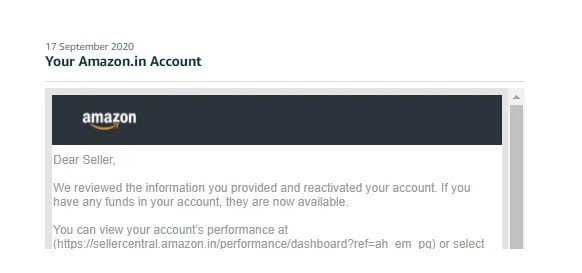
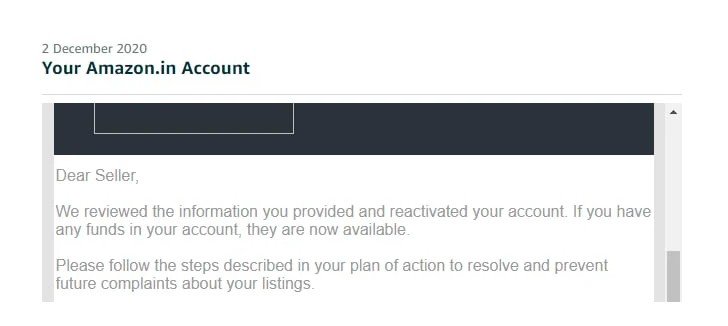
    These are reinstatement emails from client cases we handled, including cases that had been rejected before they reached us.

    Amazon email confirming a client's seller account was reinstated
    Real Amazon email from a client case
    Amazon email confirming a client's seller account was reinstated
    Real Amazon email from a client case
    Amazon email confirming a client's seller account was reinstated
    Real Amazon email from a client case

    How our fee works

    Reading your notice is free. If we take the case, you pay a small part to start and the rest only when you are selling again.

    $150To start: our full investigation ($200 for complex cases). Non-refundable.
    $350Only after your account is reinstated ($400 for complex cases).

    Complex cases are Section 3, counterfeit, related accounts, review manipulation and dropshipping. Most INFORM verification cases are standard cases.

    Frequently asked questions

    Who has to complete INFORM Act verification on Amazon?

    High-volume third-party sellers in the Amazon US store: sellers with 200 or more sales of new or unused products and $5,000 or more in gross revenue in any continuous 12-month period during the previous 24 months. Amazon can also ask sellers below that level to verify under its own policies.

    How long do I have to provide or certify my information?

    The law gives sellers 10 days. Amazon must collect the information within 10 days of a seller becoming high-volume, and must suspend sales activity if a seller does not provide it, or does not complete the annual certification, within 10 days of being asked.

    Will Amazon show my address to buyers?

    If you have $20,000 or more in annual gross revenue on Amazon, the law requires Amazon to show your name, physical address and contact details to buyers. Sellers whose only address is a residence can ask for partial disclosure, which shows only the country and state.

    Is an INFORM Act deactivation permanent?

    Usually not. Most INFORM deactivations are about missing, expired or mismatched information. Once Amazon can verify correct documents, selling is normally restored, but Amazon makes the final decision and every case is different.

    How much does help with an INFORM Act deactivation cost?

    Reading your notice is free. Standard cases cost $150 to start (non-refundable) and $350 only after reinstatement. Complex cases such as Section 3, counterfeit, related accounts, review manipulation or dropshipping cost $200 to start and $400 after reinstatement.

    Get your INFORM notice reviewed for free

    Send us your notice. Our appeals team reads it and tells you honestly what we see.

    SellerReinstatement Appeals Team

    The SellerReinstatement appeals team has handled Amazon seller account reinstatement cases since 2014 across every Amazon marketplace. Every guide comes from real cases.